
A groundbreaking study published in Nature Biotechnology Just Confirmed and extended my 2025 MDPI Article Prediction
Confirming another “unexpected” predicted finding about these technologies

A recent study published in Nature Biotechnology on April 29, 2026, titled “mRNA vaccine immunity is enhanced by hepatocyte detargeting and not dependent on dendritic cell expression,” has been celebrated as groundbreaking. According to Mount Sinai,
“New Research Challenges Understanding of mRNA Vaccines and Establishes Innovative Way to Make Them More Effective.”
“Preclinical study shows non-immune cells shape mRNA vaccine responses and offers a path to more effective cancer vaccines.”
The research challenges the long-standing assumption that mRNA must be delivered to dendritic cells—professional antigen-presenting cells (pAPCs)—to initiate strong T-cell immunity. Instead, it reveals that non-immune cells, particularly muscle cells (myocytes) and liver cells (hepatocytes), play a critical and previously underappreciated role in shaping the immune response.
The study was published in the April 29, 2026, online issue of Nature Biotechnology [https://doi.org/10.1038/s41587-026-03099-z].
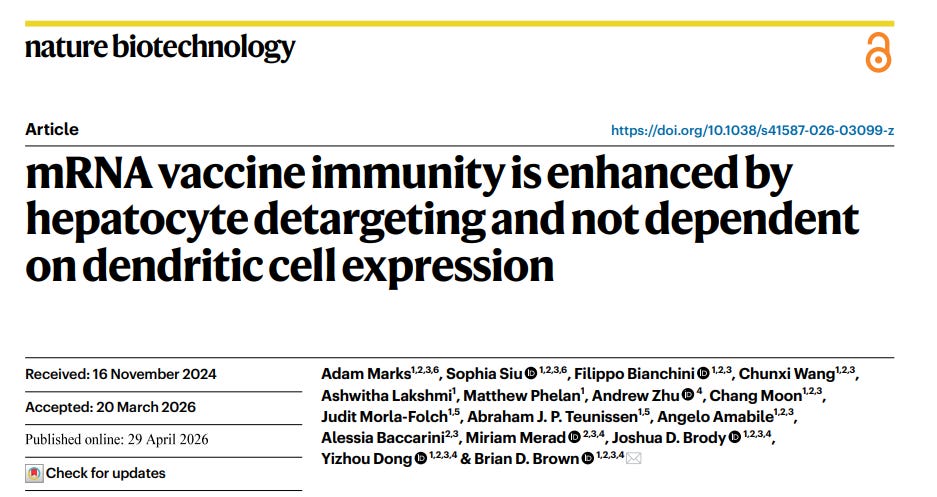
Contrary to prior belief, the study found that mRNA expression in dendritic cells is dispensable for priming antigen-specific T cells. Using synthetic microRNA target sites (miRTs) to selectively silence mRNA expression in specific cell types, the team discovered that strong T-cell responses, including against SARS-CoV-2 antigens, could be generated even when dendritic cells did not express the mRNA-encoded antigen.
This suggests that cross-presentation—where non-immune cells produce the antigen and dendritic cells acquire and present it—is a key mechanism for mRNA vaccine efficacy.
It is depicted as surprising:
“This was unexpected,” said Brian D. Brown, PhD, senior author and Director of the Icahn Genomics Institute. “It tells us that other cells are producing the vaccine antigen and handing it off to the immune system.”
“This study fundamentally changes how we think mRNA vaccines work,” says Brian D. Brown, PhD, senior author of the study and Director of the Icahn Genomics Institute at the Icahn School of Medicine at Mount Sinai.
I was thrilled to see this. After all, my MDPI article “Cross-Priming and Cross-Tolerance After Intramuscular mRNA Vaccination“ was all about these same processes:
I emphasized that muscle cells (non-APCs) are the primary site of antigen expression after intramuscular injection and that these cells cannot directly prime CD8+ T cells. Instead, I argued that cross-presentation—where professional APCs like dendritic cells acquire antigenic material from transfected non-APCs—is a key alternative pathway for activating CD8+ T cells.
The Mount Sinai study aligns directly with my prediction. The study confirms that dendritic cells do not need to be directly transfected—antigen production in non-immune cells (muscle, liver) followed by cross-presentation is sufficient and effective.
We both agree that non-immune cells actively shape immune responses via cross-presentation, something that I found particularly relevant after intramuscular injection:
In my MDPI article, based on analyses of prior vaccines, including SAM mRNA platforms, from a purely logical perspective, I saw no other alternative than that cross-presentation would be a CRUCIAL pathway following intramuscular mRNA vaccination. (I looked at it from numerous angles, describing plausible mechanisms and evidence from mRNA vaccine studies.) I maintained that this fundamental process was LARGELY underappreciated.
Likewise, the Mount Sinai study found that “direct expression of RNA-LNPs in muscle fibers contributes to the magnitude of the antigen-specific T cell response... Notably, silencing mRNA in muscle fibers decreased antigen-specific T cell expansion to a similar or greater degree compared to silencing in pAPCs. This was surprising because muscle fibers are not major APCs... A possible explanation is that myocyte expression serves as a source of exogenous antigen for cross-presentation by DCs and this is a more potent mechanism of CD8 T cell activation than direct presentation by transfected DCs...”
I have since gotten articles rejected as I based follow-up arguments on cross-presentation, something which, until recently, did not seem to have been accepted as a viable option. This is one of the reasons I am so thrilled to see my prediction confirmed. The new study also gives me new material to think about (not that I am bored, lol). In contrast, mRNA expression in hepatocytes suppressed the antigen-specific T cell response, partly through PD1/PDL1 (something I have considered important for a while already, as it has shown up in numerous other mRNA vaccine studies, but, as I argue, still remains unappreciated... more on this, sometime later).
The field is now excited. “mRNA technology is transformative for medicine,” Brown said. “Our work provides a new set of design rules for mRNA vaccines and therapeutics.
However, I would like to caution. The more I learn about mRNA vaccines, the more I find out how little we actually know. A year ago, when I was writing the MDPI article, I was confused. For the longest time, I thought it could not be true that I had discovered this foundational gap. Reviewers pushed back, compelling me to scrutinize things deeply. A detailed literature search revealed that, truly, then, this alternative process had been largely ignored in mRNA vaccine studies, despite playing a key role in other platforms, including earlier mRNA self-amplifying technologies.
It is something that keeps unfolding daily — why I have not written much on Substack. From a purely scientific perspective, mRNA vaccines are a gold mine. For many years now, I have not gone a single day without learning something new that was “unexpected.” Accordingly, prior narratives continually get updated as the field seeks to “correct” outdated views.
With these technologies, I seriously doubt that anyone on Earth has a complete grasp of their highly complex mode of operation, which arguably should have been admitted in 2021, before the mass vaccine rollout.
Sadly, some of the aspects I described in my MDPI article also have potential for serious downsides and risks. So far, these have remained widely unexplored....
The gold rush continues. As a scientist, I am thrilled about the progress. I hope all of this will also benefit those who matter the most: individuals!
Thanks for your valuable work! Yes, I also seriously doubt that anyone on Earth, including any drug authority like EMA/FDA/WHO, etc. has a complete grasp of their highly complex mode of operation - yet, humans are subject to experimentation!
Thank You, Siguna! The dates tell the story: Recieved 16 November 2024. Accepted 20 March 2026. Published 29 April 2026.